Threat Intelligence: How to Predict Cyber Attacks
Threat intelligence helps you predict cyber attacks: how to spot early warning signs, sources, and steps to roll it out in your company in B
Read
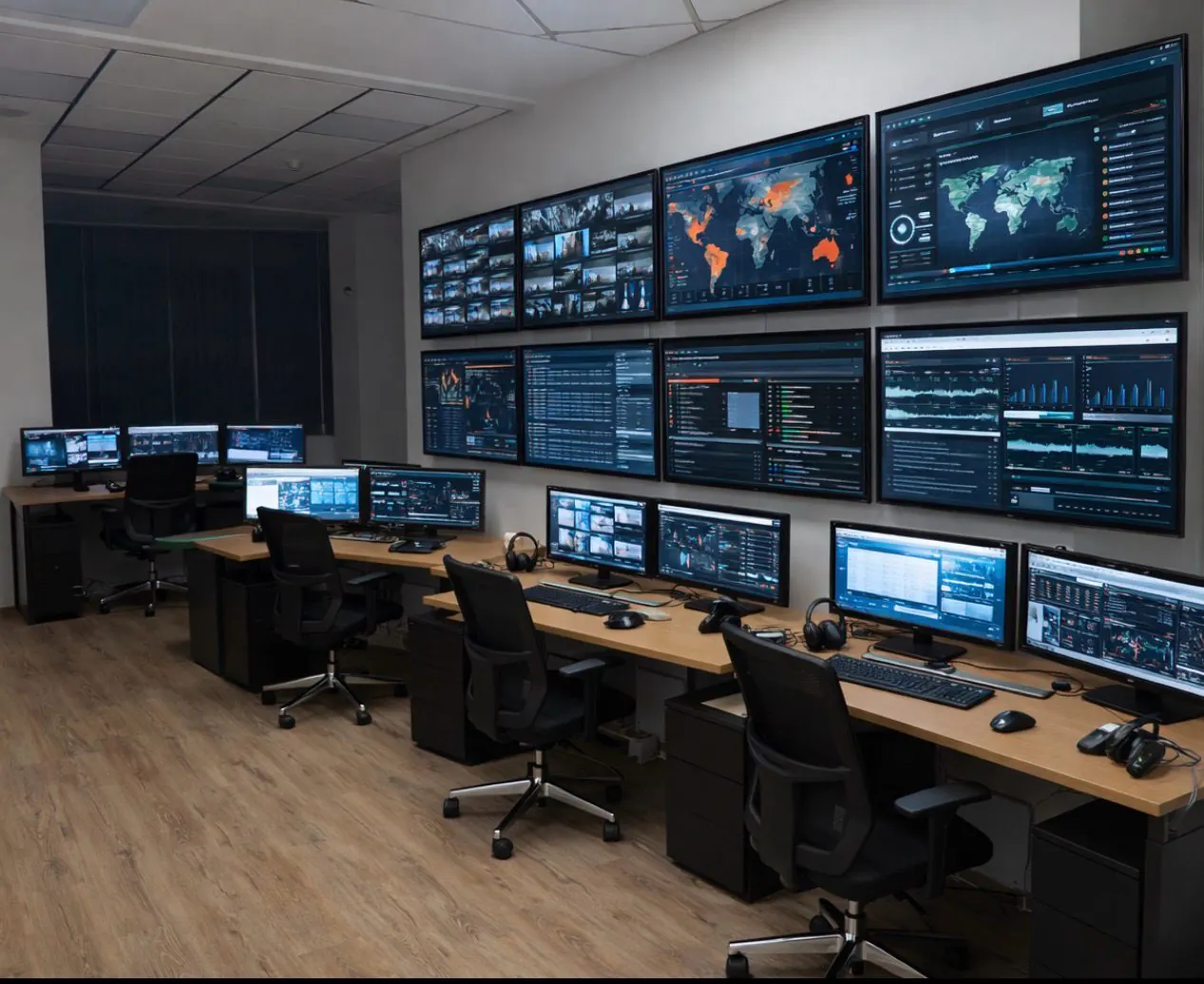
A security operations center (SOC) is a team of people, processes, and technology that continuously monitors your IT environment, detects suspicious activity, and responds to security incidents before they escalate into serious damage. Put simply: a SOC is the «watch tower» of your digital infrastructure, working 24 hours a day, 7 days a week. Does your company need one? If you hold data you cannot afford to lose, run systems that cannot go down, and have an obligation to protect your clients, the answer is almost always «yes». The only question is whether you build it yourself or buy it as a service.
24/7 SOC service - 24/7 monitoring, detection, and response to cyber threats. You do not have to do it alone; we handle it for your company. Request a free assessment.
A security operations center is not just a room full of big screens and red alarms like the ones you see in films. It is an organizational function that brings together three things: skilled people, clearly defined processes, and security tools. The goal is that no attack, data leak, or anomaly goes unnoticed and, more importantly, that someone actually responds to every threat.
In practice, a SOC carries out several key tasks that repeat every day:
Without a SOC, most companies only learn they have been attacked once it is too late, when their data has already been encrypted by ransomware or when a client reports that their data has been stolen. A SOC exists precisely to shorten the time between the moment an attack begins and the moment someone notices and stops it.
A well-organized security operations center relies on several roles that together form the layers of defense. Although the titles vary from company to company, the structure is usually as follows:
The technological foundation of any SOC usually includes:
It is important to understand that tools alone do not make a SOC. A firewall and antivirus are essential, but they only build the walls. A SOC is the team that watches who is trying to climb over those walls and what they do once they succeed. Many companies in the region buy expensive security tools but have no one monitoring what those tools report around the clock. That is like having an alarm on a building that no one is listening to.
This is the most important practical decision for most companies in Bosnia and Herzegovina and the wider region. Building your own security operations center means hiring a team that covers every shift, procuring and maintaining tools, and providing ongoing training. For a small or medium-sized company, that is very expensive and difficult to sustain. Finding and retaining experienced analysts in the labor market in Bosnia and Herzegovina is a serious challenge in itself.
That is why more and more companies are choosing SOC as a service, today most often in the form of MDR (Managed Detection and Response). Instead of building an entire department, an external team takes over monitoring and response for an agreed monthly fee. Let us look at the differences:
| Criterion | In-house SOC | SOC as a service (MDR) |
|---|---|---|
| Initial cost | High (people, tools, premises) | Low, predictable monthly fee |
| Time to launch | Months | Days to a few weeks |
| 24/7 coverage | Requires multiple shifts and a team | Included in the service |
| Expertise | Depends on who you hire | A team already working with multiple clients |
| Control | Full, everything is in-house | Shared with the service provider |
| Suitable for | Large organizations with specific requirements | Small and medium-sized companies, most of the region |
For the vast majority of companies in Mostar and beyond, MDR is a reasonable starting point: you get genuine 24/7 monitoring and incident response without the cost of building an entire department. NeoBit offers exactly this model through its NeoBit SOC 360 service, tailored to the size and needs of your company.
Not every company needs its own SOC, but almost every company needs some form of security monitoring. To assess how urgent it is for you, answer the following questions honestly:
If you answered yes to several of these questions, it is very likely that you need systematic security monitoring. The more risk your business carries, the stronger the case for a SOC or MDR service.
It is good practice not to buy a SOC «blindly». The first step is to understand where you really stand. That means assessing your current security posture, and often penetration testing to check how resilient you actually are to attack. Only once you know your weak points does it make sense to build monitoring around them. If you are not sure where to begin, a short penetration testing questionnaire is a good way to define the scope and priorities.
It is also worth stressing this: a SOC is not a substitute for basic security hygiene. Regular patching, two-factor authentication, backups, and employee training remain the foundation. A SOC is a layer above that: it assumes that some attack will get through the basic defenses anyway and ensures that someone notices and stops it in time.
To make it clearer why response time is decisive, let us imagine a typical scenario. An employee opens an attachment from a phishing email, and malicious code lands on their computer. Without a SOC, that code can quietly harvest passwords and spread through the network for days. With a security operations center, the sequence is entirely different:
Two metrics are key measures of a SOC's quality: the mean time to detect a threat (MTTD) and the mean time to respond (MTTR). The lower these two numbers, the less damage an attack can cause. A good SOC constantly works to reduce them.
Working with companies in Bosnia and Herzegovina and the region, the same misconceptions come up again and again, and they are worth avoiding:
A SOC, whether in-house or as a service, directly addresses all of these points because it brings monitoring, centralized logs, and a clear response plan together into a single whole.
A security operations center turns security from the passive «we bought an antivirus» mindset into an active defense that genuinely monitors what is happening and responds when needed. For large organizations, that can mean an in-house team; for most small and medium-sized companies in Bosnia and Herzegovina and the region, the practical path is MDR, that is, SOC as a service. If you are not sure what is right for you, the best first step is a conversation with experts who will assess your risk without unnecessary scaremongering. Feel free to reach out to the NeoBit team via our contact page and arrange a free initial consultation.
An antivirus and a firewall are tools that automatically block known threats. A security operations center is a team of people who, with the help of those and more advanced tools, continuously monitor the entire environment, investigate suspicious activity, and respond to attacks that get through the basic defenses. A tool builds a wall; a SOC watches who tries to get past it and takes action.
The price depends on the size of the environment, the number of devices, and the level of service. Building your own SOC is very expensive because of the cost of the team and tools, whereas a SOC as a service (MDR) works on a predictable monthly fee that is affordable even for smaller companies. You will get the most accurate estimate after a brief review of your infrastructure.
Yes. That is exactly why the SOC as a service model exists. An external team takes over monitoring and response, so even companies without a large internal IT department do not have to go without 24/7 monitoring. It is a common choice for companies in Mostar and the region that want serious protection without building their own department.
A SOC significantly reduces the risk of ransomware because it detects, early on, the suspicious activity that precedes data encryption and enables the rapid isolation of infected devices. There is no hundred-percent guarantee, but rapid detection and response are often the difference between a minor incident and a complete halt to business operations.
Related guides: Cyber Security in Bosnia and Herzegovina - the complete guide · EDR, XDR, and SIEM - the differences explained simply · What Is MDR (Managed Detection and Response) and Who Needs It?
 SOC
SOCThreat intelligence helps you predict cyber attacks: how to spot early warning signs, sources, and steps to roll it out in your company in B
Read SOC
SOCMDR is a 24/7 service for monitoring, detecting and responding to attacks. Learn who needs it, how it differs from a SOC and how to choose a
Read SOC
SOCEDR, XDR and SIEM differences: what each technology protects, how they complement each other and which one your company needs. A practical g
Read