Hackers Wiped Romania's Land Registry
Romania's cadastre (ANCPI) hacked in July 2026: leaked passwords and unpatched vulnerabilities took down e-Terra. Less
Read
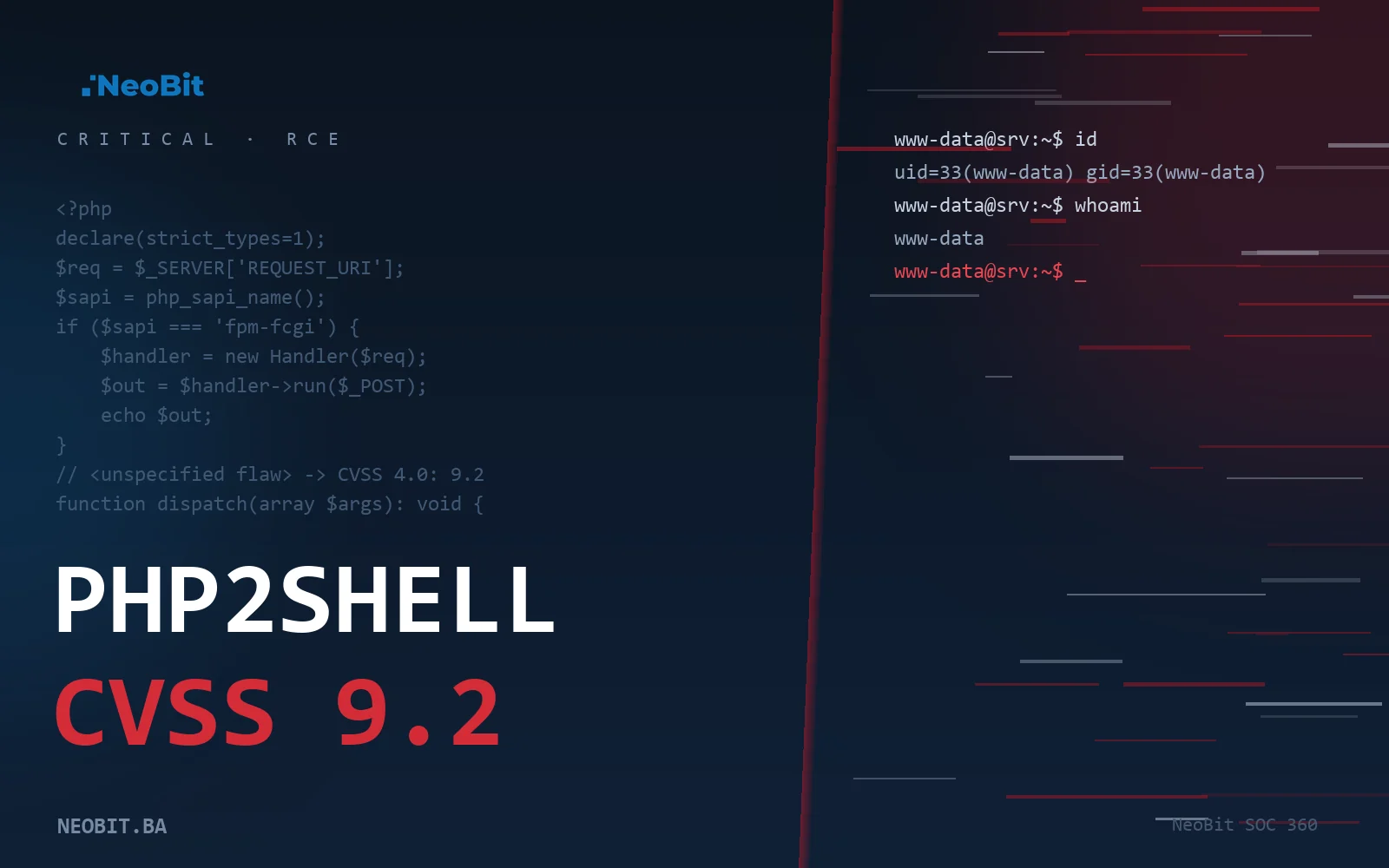
On Wednesday, 21 October 2026, at 14:00 UTC (16:00 in BiH), PHP has scheduled an out-of-cycle security release to fix two critical bugs. PHP scores both 9.2 under CVSS v4.0, and researchers at watchTowr say they let an attacker run code remotely (RCE). PHP has not yet published a technical description, and no attacks have been reported. The pair already has a nickname: "php2shell".
This article reflects the situation on the morning of 21 October 2026, before PHP published the release. What is confirmed and what is not is marked clearly below. We will update it as soon as PHP publishes the details.
Based on reporting by The Hacker News (author Swati Khandelwal, 21 October 2026), together with PHP's own notice and material from watchTowr, Huntress, Mallory and CERT-EU. The section for companies in BiH and the recommendations are NeoBit's.
PHP's notice, posted on 20 October, is very short. It gives the release slot, says two critical vulnerabilities are being fixed, scores each 9.2 on CVSS v4.0, and promises details and affected and fixed versions only once the update is out. It also warns the release may come early if the bugs become public or start being exploited. No CVE numbers appear in it.
The notice followed a leak. A post on news.ycombinator.com on 20 October claimed two PHP remote-code-execution bugs, scored 10.0 and reaching back to PHP 5, would be disclosed on 22 October; its author offered no proof. watchTowr then said on X that the leak was genuine and the bugs were under embargo. PHP then set its release a day before the date in the post. What leaked was a rating, a disclosure date and a pair of CVE numbers, with no technical explanation. So it helps to separate what is confirmed from what is merely repeated:
| Claim | Status |
|---|---|
| Two critical flaws, CVSS v4.0 9.2 | Confirmed by PHP |
| Release on 21 October 2026 at 14:00 UTC | Confirmed by PHP |
| The flaws are RCE | Stated by watchTowr; PHP has not yet described them |
| CVSS 10.0 rating | Only from the leaked post; PHP says 9.2 |
| Every version from PHP 5 is affected | Unconfirmed; no official vendor advisory says so yet |
| CVE-2026-109618 and CVE-2026-109619 | Identifiers from the leaked post that researchers use; PHP does not name them |
| Releases 8.5.12, 8.4.27, 8.3.36 and 8.2.35 | Expected by trackers (e.g. Alpine Linux, Kevin Beaumont); not confirmed by PHP |
Still unknown: the exact version range, the vulnerable component, and whether an attack needs a special configuration, run mode or login. The release should settle all of that.
Fixes are expected only for the four supported branches, PHP 8.2 to 8.5. Support status according to php.net:
| Branch | Latest release before this one (24 September) | Support status | Security support until |
|---|---|---|---|
| 8.5 | 8.5.11 | active support until 31 Dec 2027 | 31 Dec 2029 |
| 8.4 | 8.4.26 | active support until 31 Dec 2026 | 31 Dec 2028 |
| 8.3 | 8.3.35 | security fixes only | 31 Dec 2027 |
| 8.2 | 8.2.34 | security fixes only | 31 Dec 2026 |
Everything older, from 8.1 downward, is out of vendor support, so if those versions turn out to be affected there will be no official patch. A Shodan count by Mallory on 20 October hints at how many that could be: about 884,000 public hosts advertise PHP 8.1 or older in their banner, which is 59% of the ~1.5 million that show any version. A banner does not prove a system is vulnerable, so read the figure as a rough indication, not a list of vulnerable machines.
PHP has published no workaround, so preparation is mostly organisational. The checklist mostly follows Huntress guidance, with CERT-EU's isolation advice and a tool by Florian Roth added (as summarised by The Hacker News).
There is no public sign of exploitation so far: watchTowr's FAQ lists none, the bugs are absent from CISA's KEV list, and Huntress, as of 20 October, had seen nothing among its partners and knew of no public exploit code. History argues against complacency, though: after CVE-2024-4577 (PHP in CGI mode on Windows) went public in June 2024, Akamai recorded attacks on its honeypots in under 24 hours.
PHP runs a huge part of the web: WordPress, Joomla, Drupal, Magento and WooCommerce, plus many custom-built business applications and portals. In our experience, many companies in BiH do not maintain PHP themselves but get it through a hosting provider, a web agency or a software vendor, so it is often unclear which version is running and who owns the patch. That is the biggest risk in the days after disclosure. Our recommendation:
Why fast patching of known vulnerabilities is decisive is also shown by our analysis of the attack on Romania's land registry.
NeoBit combines 24/7 SOC monitoring, web application penetration testing and infrastructure management - so that the patch is not your only line of defense. If you suspect a system is already compromised, report the attack. Request a free assessment.
An unofficial name researchers gave to a pair of critical RCE flaws in PHP; PHP itself does not use it. PHP rated both 9.2 on CVSS v4.0 and will publish the details with the release scheduled for 21 October 2026 at 14:00 UTC.
Not confirmed yet; PHP will name them with the release. Fixes are expected only for branches 8.2 to 8.5 (PHP patches only supported branches), and older branches are not expected to get an official patch. The leak's claim that everything since PHP 5 is affected has not been confirmed.
As of 21 October 2026 there are no reports of exploitation. Inventory every PHP installation, prepare the upgrade and patch internet-facing systems first; upgrade old branches or shield them with a VPN or WAF. Earlier cases show attacks can start quickly, so do not postpone the patch.
This news item draws on reporting by The Hacker News (author Swati Khandelwal), to whom we give credit, and on PHP's official notice on php.net. Exposure data comes from Mallory, technical claims from the watchTowr team, and preparation guidance from Huntress and CERT-EU. The text is our own write-up, not a translation of the original article.
 Analysis
Romania's cadastre (ANCPI) hacked in July 2026: leaked passwords and unpatched vulnerabilities took down e-Terra. Less
Read Pen Testing
Web application penetration testing finds and proves exploitable vulnerabilities in your app and delivers a report with remediation recommen
Read Pen Testing
OWASP Top 10 explained: all ten most common web vulnerabilities, attack examples and practical protection steps for companies in BiH and the
Read